HR Software for Small Business: Costs, PEOs and How to Choose
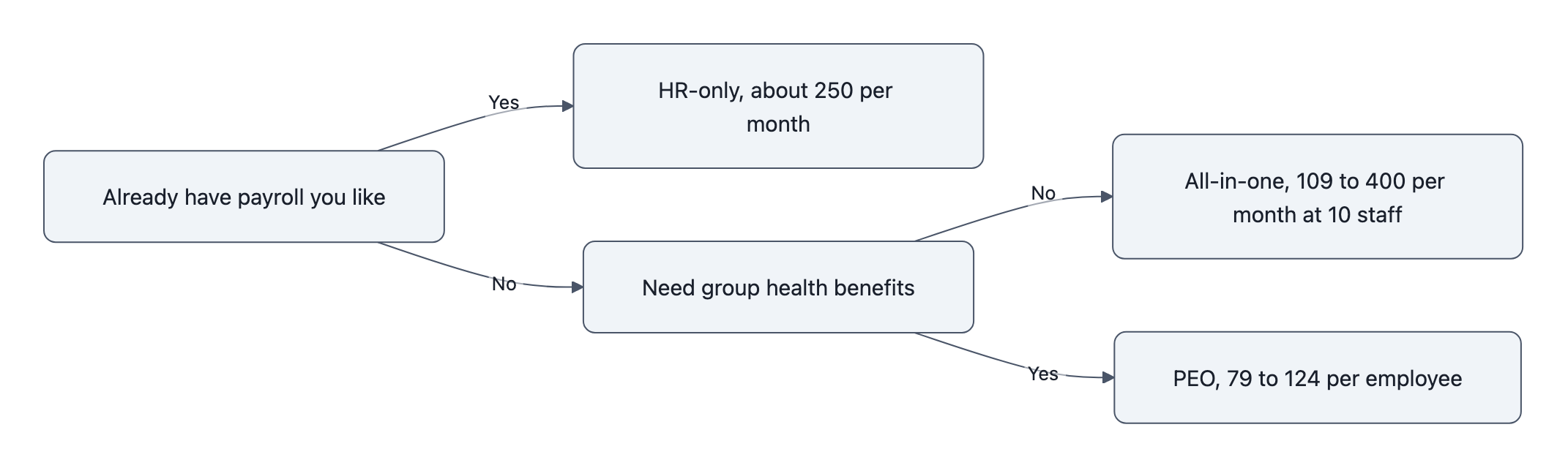
At 10 employees, list prices as of November 2026 are about $109 to $400 a month for an all-in-one HR and payroll platform such as Gusto, and $790 to $1,240 a month for a PEO such as Justworks. Health premiums are extra in both cases. With HR-only software or an all-in-one platform, you stay liable for federal employment taxes even when the vendor files them. The extra PEO cost buys a seat in the PEO's pooled health plan and, only if the PEO is IRS-certified, a transfer of that tax liability. It does not buy better software.

Pick the model that fits your situation:
- HR-only software such as BambooHR, if you already run payroll you like.
- An all-in-one HR and payroll platform such as Gusto or Rippling, if you want one system and one bill.
- A PEO such as Justworks, if you want its pooled group health plan. If the PEO is IRS-certified, you also hand off federal employment tax liability.
At a glance
These are monthly totals at list prices as of November 2026. Health premiums are extra in every row.
| Option | 5 staff | 10 staff | 25 staff | Source, year |
|---|---|---|---|---|
| BambooHR Core (HR only, payroll extra) | $250 | $250 | $250 | BambooHR pricing page, 2026 |
| Gusto Simple to Premium (HR and payroll) | $79 to $290 | $109 to $400 | $199 to $730 | Gusto, 2026 |
| Justworks Payroll (no PEO) | $90 | $130 | $250 | Justworks pricing page, 2026 |
| Justworks PEO Basic to Plus | $395 to $620 | $790 to $1,240 | $1,975 to $3,100 | Justworks pricing page, 2026 |
| Rippling | Quote | Quote | Quote | Rippling pricing page, 2026 |
Gusto: Simple $49 + $6 per person, Plus $80 + $12, Premium $180 + $22. Justworks: Payroll $50 + $8 per employee, PEO Basic $79 and PEO Plus $124 per employee with no base fee. Gusto repackaged its plans on October 1, 2026, so confirm current figures on Gusto's pricing page and Justworks' pricing page before you sign.
Three ways to buy, and what you stay liable for
HR software, also called an HRIS (human resources information system), is the system of record for your people. It holds employee records, onboarding paperwork, time off and signed documents. The three buying models differ most in who pays when a tax deposit is late.
HR-only software sits beside the payroll you already run. It stores records and takes on no legal duty.
An all-in-one platform runs payroll and HR together. The IRS treats it as a payroll service provider. Under the IRS Third Party Arrangement Chart, the employer "remains liable for ensuring all tax returns are filed timely and all deposits and payments are made timely."
That risk has played out before. When MyPayrollHR collapsed in September 2019, it had about 4,000 clients, and about $35 million went missing, including more than $9 million meant for payroll taxes. The employers stayed liable for the unpaid taxes plus interest and penalties, according to Covington.
A PEO (professional employer organization) becomes a co-employer of your staff. It runs payroll under its own tax accounts and offers its group health plans. The IRS chart says an IRS-certified PEO (CPEO) takes on federal employment tax liability for your worksite employees. A non-certified PEO does not automatically take on that liability.
Most PEOs are not certified. NAPEO, the industry association, counted 502 PEOs as of September 2026. Secondary estimates put the number of CPEOs at about 90, a figure not confirmed against the IRS list. Justworks announced in 2017 that it was among the first certified PEOs.
Check any PEO's legal name on the IRS active CPEO list, which is linked from the IRS CPEO page.
| Duty | HR-only software | All-in-one platform | PEO |
|---|---|---|---|
| Federal employment tax liability | You | You, even though the vendor files | Shifts only if it is a CPEO |
| Keeping records for 1 to 3 years | You | You | Still your duty; the contract should say who holds which records |
| Group health benefits | Small-group plan through a broker | Same, with benefits admin available | PEO's pooled plan, premiums billed on top of fees |
| State registrations and filings | You | Gusto sells this at $85/state/month on Simple and Plus | Ask exactly what the contract covers |
HR software cost: what you'll pay at 5, 10 and 25 employees
The At a glance table shows the totals. Four patterns matter when you read it.
Base fees weigh hardest on small teams. Gusto Premium's $180 base fee makes it $290 a month at 5 people, or $58 a head. At 25 people it costs $730, or $29.20 a head.
BambooHR is a flat minimum, not a base fee. Core is $250 a month for any team of 25 or fewer. That is $50 a head at 5 staff and $10 a head at 25, before you add payroll. Above 25 employees, it switches to per-employee pricing of $10 on Core, $17 on Pro and $25 on Elite.
PEOs scale in a straight line. At 25 staff, Justworks costs about $23,700 a year on Basic and $37,200 on Plus. Gusto Premium costs about $8,760 a year at the same headcount. Gusto's middle tier, Plus, runs $140, $200 and $380 a month at 5, 10 and 25 people.
The same vendor shows what the PEO fee buys. Justworks Payroll, sold without the PEO, costs $8 per employee plus a $50 base fee. At 25 staff that is $250 a month, or $3,000 a year. Justworks PEO Basic costs $1,975 a month at the same headcount. The roughly $20,700 a year difference pays for co-employment: the pooled health plan and the certified-PEO tax transfer. It does not pay for a different payroll product.
For PEOs other than Justworks, the typical industry range is $40 to $160 per employee per month, or 2% to 12% of payroll. Business News Daily and the U.S. Chamber of Commerce's CO site report this range, and both carry advertising. Use it as a benchmark, not a quote.
Rippling publishes only a starting price of "$8 per employee per month, with a monthly base fee," so get a written quote for the modules you need.
What a PEO's health plan actually buys
You can offer group health coverage under any of the three models. With HR-only or all-in-one software, you buy a small-group plan through a broker. What a PEO sells is entry to its own pooled plan.
Premiums dwarf the fees. KFF's 2025 Employer Health Benefits Survey found that firms with 10 to 199 workers paid an average of $9,211 a year for single coverage. For 10 staff on single coverage, that is about $7,700 a month in premiums, against $790 to $1,240 in PEO fees. Workers pay part of the premium through payroll deductions.
The savings claims come from the industry. NAPEO claims a "27% return on investment" for PEO clients. These are association figures, not independent measurements.
Who saves depends on your team. The Congressional Budget Office reported in September 2026 that PEO plans can be experience-rated, which means they are priced on the group's own claims history. From 2014 to 2024, premiums on experience-rated small-employer plans rose 35%. Premiums on ACA community-rated plans, which charge one price across a whole pool, rose 46%.
CBO calls that pattern "consistent with adverse selection": healthier groups leave the community-rated pool. A younger, healthier team stands to gain from a PEO plan. An older team has less to gain. Get an independent broker quote at the same time as any PEO quote.
What changes the price
- Plan tier. At 10 people, Gusto Premium costs about 3.7 times Gusto Simple.
- Add-ons. BambooHR payroll, benefits administration and time tracking are add-ons with no published price.
- Gusto's October 1, 2026 repackaging. According to the Gusto Help Center, Business Compliance (state registrations and filings) became an $85 per state per month add-on on Simple and Plus, on an annual contract, and stays included in Premium. A team spread across three states pays $255 a month extra. The Contractor Only plan also ended.
- Who counts. Gusto prices per person, not per employee. Ask whether your contractors count.
- Discounts. BambooHR offers 15% off for bundling Payroll and Benefits, and 15% off for nonprofits.
Record-keeping rules your HR system has to handle

Your system has to store these records for the required time and let you export them. These are federal minimums. Many states set longer periods, so check your state labor department and keep each record for the longest period that applies.
| Record | Keep for | Source |
|---|---|---|
| Payroll records (hours, pay rate, wages, deductions) | 3 years | DOL Fact Sheet #21 |
| Time cards, wage-rate tables, work schedules | 2 years | DOL Fact Sheet #21 |
| Personnel and employment records | 1 year; for an involuntary termination, 1 year from that date | EEOC |
| ADEA payroll records | 3 years | EEOC |
| Records explaining pay differences (Equal Pay Act) | 2 years | EEOC |
| Benefit plans and seniority systems | While in effect, plus at least 1 year | EEOC |
| Form I-9 | 3 years after hire or 1 year after employment ends, whichever is later | USCIS M-274 |
| Records relevant to a discrimination charge | Until the charge and any lawsuit are resolved | EEOC |
The I-9 rule trips people up. If an employee leaves after 6 months, you keep the form until 3 years after the hire date. If an employee leaves after 5 years, you keep it for 1 more year.
The DOL does not require any particular system: "Any timekeeping plan is acceptable as long as it is complete and accurate."
According to the EEOC, the Equal Pay Act applies from 1 employee, Title VII and the ADA from 15, and the Age Discrimination in Employment Act from 20. The EEO-1 workforce report starts at 100 employees, or at 50 for federal contractors with $50,000 or more in contracts. Most businesses with 2 to 50 staff will never file an EEO-1, so skip upsells built around it.
How to choose: questions to ask, and red flags
Get written quotes or trials from at least two vendors. If you are weighing a PEO, also get a quote from an independent benefits broker.
- What is my total monthly cost at my current headcount, including base fee, add-ons and every state where I have staff? A demo price that leaves out add-ons is a red flag.
- Do contractors count toward per-person pricing?
- Is this a monthly or annual contract, and which add-ons carry their own annual term?
- Is my rate locked for the term, and how much notice do you give before a price change?
- Which features in your demo are add-ons, and at what price? Get unpublished prices in writing.
- How do I export all records, documents and payroll history if I leave, and in what format?
- How long do you keep my data after cancellation?
- For a PEO: what legal name will appear on the IRS CPEO list? Treat "we handle compliance" as a sales line until the contract and the list confirm it.
- For a PEO: what are the premiums for my team's ages and zip codes? Compare them with the broker quote, not with a software fee.
- Who handles state registrations, required posters and state leave rules?
Export a full copy of your records once a year, and again before any cancellation takes effect. That way you keep your 3-year payroll and I-9 records after the vendor relationship ends.
FAQ
Do I need separate HR software if I already use a payroll provider?
Not if your payroll plan already covers the HR jobs you need. Gusto bundles HR features such as onboarding and document signing with payroll, and adds more on its Plus and Premium tiers. Add BambooHR when you want a dedicated HR system beside payroll you keep. At 5 staff, its flat $250 a month works out to $50 per head.
How much more does a PEO cost than HR software?
It depends on headcount and tier. At 5 staff, Justworks PEO Basic ($395 a month) costs about 1.6 times BambooHR Core ($250). At 25 staff, Justworks PEO Plus ($3,100) costs about 15.6 times Gusto Simple ($199). Add health premiums to every option before you compare, because premiums run far larger than any of these fees.
Should a very small business consider a PEO at all?
Only if you plan to offer health coverage. KFF found that 59% of firms with 10 to 199 workers offered health benefits in 2025. Among firms with 3 to 9 workers, 39% did in 2023, the last year KFF measured them. Without a health plan, the PEO's main draw falls away, and your choice is between HR-only software and an all-in-one platform.
Does HR software keep me compliant automatically?
No. Software stores records and sends reminders, but the legal duty to keep accurate records stays with you. For state rules or a dispute, check with your state labor department or an employment attorney. For tax liability questions, ask a licensed tax professional.
Key takeaways
- Price the full bill: base fee, per-person fee, add-ons, states and health premiums, all at your real headcount.
- Test the PEO's health plan against an independent broker's small-group quote.
- Verify PEO certification on the IRS CPEO list, not in a sales deck.
- Keep your own exports of payroll records (3 years), personnel records (1 year) and I-9s (the later-of rule).
The bottom line
First, decide whether you will offer group health coverage. If you will, get a PEO quote and a broker quote side by side. Next, get written quotes from two or three vendors at your real headcount, with every add-on and state included, and check any PEO on the IRS CPEO list. Finally, lock the rate and term in writing: Gusto repackaged its plans on October 1, 2026 and moved state compliance into an annual-term add-on. The DOL has also proposed new joint-employment and independent contractor rules that bear on PEO co-employment, so check their status at dol.gov/agencies/whd before you sign a multi-year PEO deal.
Sources
- BambooHR Plans and Pricing (BambooHR, 2026)
- Gusto Pricing (Gusto, 2026)
- What's new with Gusto plans, starting October (Gusto Help Center, 2026)
- Justworks Pricing (Justworks, 2026)
- Justworks Is One of First Companies to Become a Certified Professional Employer Organization (Justworks press release via GlobeNewswire, 2017)
- Rippling Pricing (Rippling, 2026)
- PEO vs. HRO differences (Business News Daily, carries advertising, 2026)
- PEO vs. HRO (U.S. Chamber of Commerce CO, carries advertising; used for the industry range only, 2026)
- 2025 Employer Health Benefits Survey (KFF, 2025)
- Health benefits of US firms with 3 to 9 workers (Statista, KFF data, 2023)
- Experience-rated and community-rated small-employer premiums (Congressional Budget Office, September 2026)
- PEO Industry Statistics (NAPEO, industry association, 2026)
- MyPayrollHR scandal serves as reminder to verify employment tax deposits (Covington & Burling, 2019)
- Fact Sheet #21: Recordkeeping Requirements under the FLSA (U.S. Department of Labor, Wage and Hour Division, accessed November 2026)
- Wage and Hour Division (U.S. Department of Labor, accessed November 2026)
- Recordkeeping Requirements (U.S. Equal Employment Opportunity Commission, accessed November 2026)
- Small Business Requirements (U.S. Equal Employment Opportunity Commission, accessed November 2026)
- Handbook for Employers M-274: Retaining Form I-9 (U.S. Citizenship and Immigration Services, accessed November 2026)
- Third Party Arrangement Chart (Internal Revenue Service, accessed November 2026)
- Certified Professional Employer Organization (Internal Revenue Service, accessed November 2026)
- Active CPEO list (Internal Revenue Service, 2026)